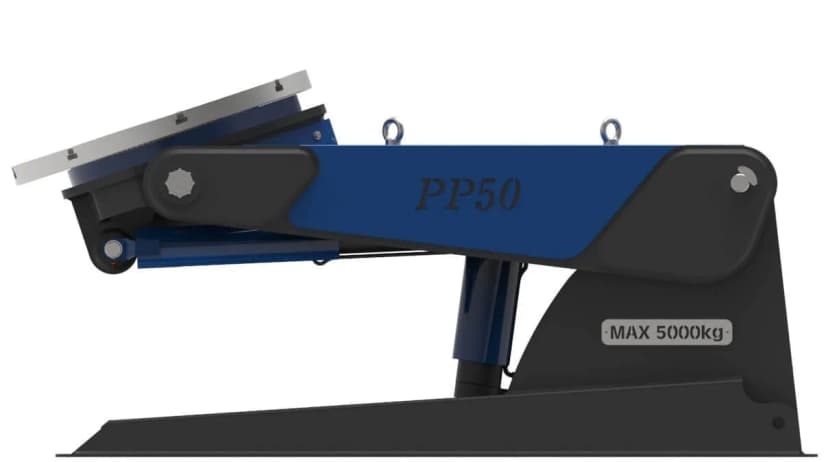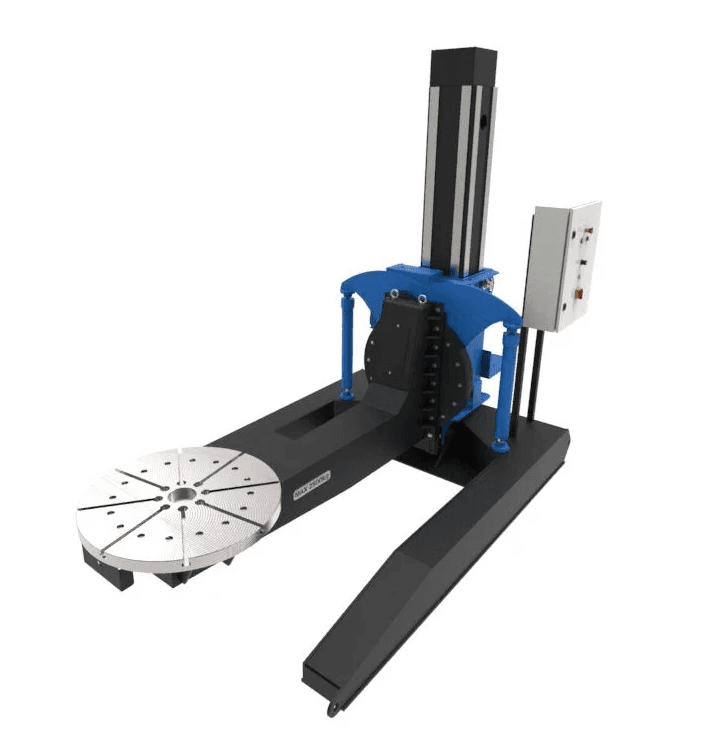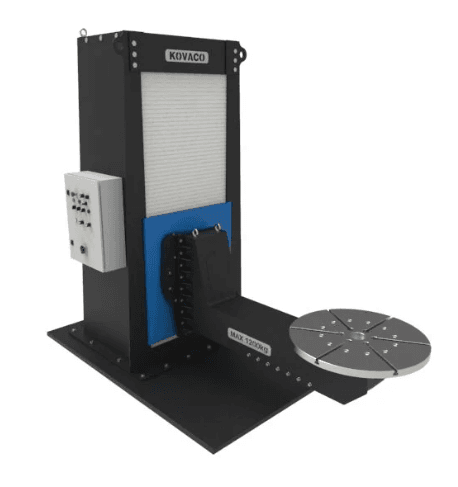
Take the weight of the weldment together with its fixture, then check where its centre of gravity sits. For 1 tonne that means PP 15, SP 12 or SPK 12; for 5 tonnes PP 50, SP 50 or SPK 50; for 10 tonnes PP 100, SP 100, SPK 100 or the double-column SPK 50-D. Whether the smaller of two candidates is enough is decided by torque, not by weight: a long part with its centre of gravity far from the table needs the next size up.
Every positioner in the catalogue has a bearing capacity, and most people stop reading there. The number that catches them out is the one below it. A PP 30 carries 3,000 kg, but its table tilting moment is 10,000 Nm, and a 3,000 kg weldment uses all of that when its centre of gravity sits just 0.34 m from the tilt axis. Put the same weight on a fixture that holds it 0.6 m out and the positioner is overloaded, although the scale says it is fine.
How do I work out the moment my weldment needs?
Multiply the weight by the distance of the centre of gravity from the axis, and by 9.81 to get newton metres. A 2,000 kg frame whose centre of gravity is 0.4 m from the tilt axis needs 2,000 × 9.81 × 0.4 = 7,850 Nm. A PP 15 (3,000 Nm) cannot tilt it; a PP 30 (10,000 Nm) can, with reserve.
Do the same for rotation. When the table stands vertical, any offset of the centre of gravity from the rotation axis loads the table drive. The PP 30 has 5,300 Nm of table torque, which for 2,000 kg allows an offset of 0.27 m. Asymmetric weldments eat this up quickly, so measure the offset rather than guess it.
The fixture counts twice: it adds weight, and it pushes the part further from the table.
KOVACO positioner types and their capacity range
| Type | For | Bearing capacity | Sizes |
|---|---|---|---|
| SPK | Manual positioners | from 1,200kg to 15t | SPK 12, SPK 25, SPK 50, SPK 100, SPK 150 |
| PP | Manual positioners | from 800kg to 10t | PP 8, PP 15, PP 30, PP 50, PP 100 |
| SP | Manual positioners | from 600kg to 15t | SP 6, SP 12, SP 25, SP 50, SP 100, SP 150 |
| SPK-D | Manual positioners | from 2,400kg to 30t | SPK 12-D, SPK 25-D, SPK 50-D, SPK 100-D, SPK 150-D |
| SP-DL | Manual positioners | from 2,400kg to 20t | SP 12-DL, SP 25-DL, SP 50-DL, SP 100-DL |
| SPK-BZ-D | Manual positioners | from 600kg to 5t | SPK 6-BZ-D, SPK 12-BZ-D, SPK 25-BZ-D |
| SPK-HO-R | Robotic positioners | from 600kg to 5t | – |
| SPK-D-R | Robotic positioners | from 1,200kg to 30t | – |
| SPK-BZ-DP-HO-R | Robotic positioners | from 600kg to 5t | – |
| SPK-BZ-HR-HO-R | Robotic positioners | from 600kg to 5t | – |
| SPK-R | Robotic positioners | from 600kg to 15t | – |
| SPK-BZ-D-R | Robotic positioners | from 1,200kg to 30t | – |
| SPK-BZ-DR-HO-R | Robotic positioners | from 600kg to 5t | – |
From the KOVACO catalogue, generated from the current product data.
Which type suits which job?
- PP: a compact three-axis unit for simpler work, 800 kg to 10 t, no anchoring. The table tilts to about 100°.
- SP: three independent axes with a rotating arm, 600 kg to 15 t, no anchoring. The arm torque is the figure to check here: 10,590 Nm on the SP 25, 53,250 Nm on the SP 100.
- SPK: the fully covered version of the same kinematics, 1,200 kg to 15 t. It has to be anchored.
- SPK-D and SP-DL: double-column, for long parts held at both ends, up to 30 t.
When do I need a double-column positioner?
When the part is long. A single-column positioner holds the weldment on one table, so a 6 m beam hangs out like a lever and the moment grows with every metre. A double-column type clamps it at both ends and only has to rotate it. That is why the SPK 50-D carries 10,000 kg with 61,184 Nm of torque while taking a part the single-column SPK 100 could not hold safely.
What should I send to get a size confirmed?
- the weight of the weldment and of the fixture, separately if you can
- outer dimensions and, if known, the position of the centre of gravity
- which movements you need: lift, tilt, rotation
- manual or robotic welding, and how many pieces a year
A drawing or a STEP file is the fastest route. With these an engineer names the type and size, usually within 48 hours.
Summary
Start from the weight with the fixture, then check the moment: weight × 9.81 × the distance of the centre of gravity from the axis, compared with the tilting moment and the table torque in the parameter table. 1 t fits a PP 15, SP 12 or SPK 12; 5 t a PP 50, SP 50 or SPK 50; 10 t a PP 100, SP 100, SPK 100 or SPK 50-D. Long parts belong on a double-column type. If the numbers land close to a limit, take the next size.
Related questions
Does a welding positioner have to be anchored to the floor?
It depends on the type. PP and SP work without anchoring. SPK and the double-column types SPK-D, SP-DL and SPK-BZ-D require anchoring.
What is the largest weldment a KOVACO positioner handles?
30 tonnes, on the double-column SPK-D and the robotic SPK-BZ-D-R and SPK-D-R types.
Send us your part or your machine
An engineer answers for your case within 48 hours: the type, the size and what it takes to fit.