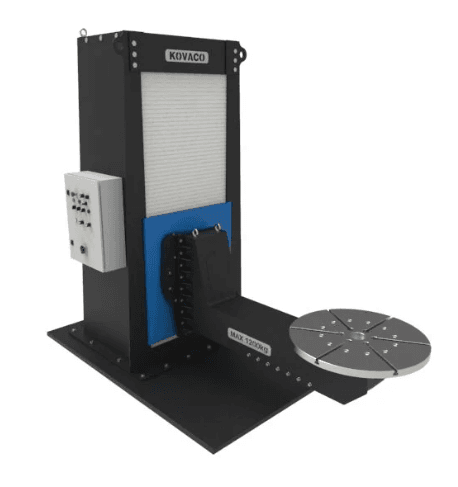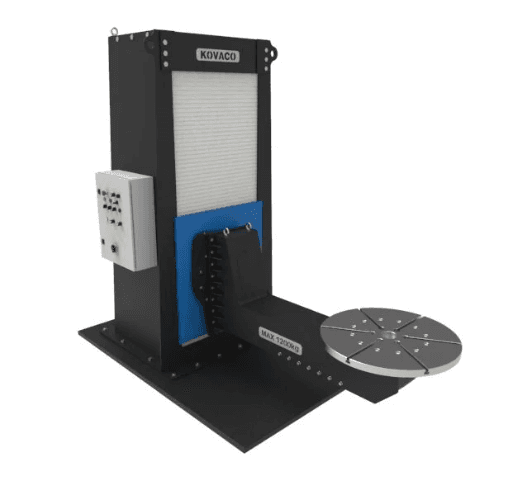
A manual positioner puts the part where a welder needs it: the operator sets the position and the rotation speed, steplessly, with a START-STOP system. A robotic positioner is an axis of the welding cell: its gearboxes are built for servomotors, so the robot controller moves the part in step with the torch. KOVACO builds both, 6 manual and 7 robotic types.
The two look alike from across the hall: a frame, a table, a part turning on it. The difference is in who commands the movement and how precisely the machine has to obey. A welder corrects by eye and does not care about a tenth of a degree. A robot repeats a programmed path and welds exactly where it was told, so the part must arrive in the same place every time.
What makes a positioner robotic
Precision. KOVACO robotic positioners use precise cycloidal gearboxes for table and arm rotation, and ball screws for lifting on the three-axis types. The interface of each axis gearbox is adapted to the servomotors the customer specifies, which is how the positioner is matched to the robot and its controller.
Manual and robotic types side by side
| Type | For | Bearing capacity | Sizes |
|---|---|---|---|
| SPK | Manual positioners | from 1,200kg to 15t | SPK 12, SPK 25, SPK 50, SPK 100, SPK 150 |
| PP | Manual positioners | from 800kg to 10t | PP 8, PP 15, PP 30, PP 50, PP 100 |
| SP | Manual positioners | from 600kg to 15t | SP 6, SP 12, SP 25, SP 50, SP 100, SP 150 |
| SPK-D | Manual positioners | from 2,400kg to 30t | SPK 12-D, SPK 25-D, SPK 50-D, SPK 100-D, SPK 150-D |
| SP-DL | Manual positioners | from 2,400kg to 20t | SP 12-DL, SP 25-DL, SP 50-DL, SP 100-DL |
| SPK-BZ-D | Manual positioners | from 600kg to 5t | SPK 6-BZ-D, SPK 12-BZ-D, SPK 25-BZ-D |
| SPK-HO-R | Robotic positioners | from 600kg to 5t | – |
| SPK-D-R | Robotic positioners | from 1,200kg to 30t | – |
| SPK-BZ-DP-HO-R | Robotic positioners | from 600kg to 5t | – |
| SPK-BZ-HR-HO-R | Robotic positioners | from 600kg to 5t | – |
| SPK-R | Robotic positioners | from 600kg to 15t | – |
| SPK-BZ-D-R | Robotic positioners | from 1,200kg to 30t | – |
| SPK-BZ-DR-HO-R | Robotic positioners | from 600kg to 5t | – |
From the KOVACO catalogue, generated from the current product data.
How precise does a robotic positioner have to be?
Precise enough that the robot never has to search for the seam. That is why KOVACO robotic types use cycloidal gearboxes, which have very little backlash, instead of the worm and spur drives that are entirely adequate for manual work. The axis is then driven by a servomotor that reports its position back to the robot controller, so table and torch move as one coordinated system.
Double-sided types for uninterrupted welding
On the double-sided rotary types the robot welds on one side while the operator exchanges parts on the other side, behind the apron. When the weld is done, the positioner turns 180° and the cycle repeats.
When a manual positioner is the right choice
For classic welding shops, single pieces and small series. The compact PP and SP types need no anchoring, so they can be moved with the work.
Summary
A manual positioner serves a welder: stepless speed, START-STOP, robust drives, and on the PP and SP types no anchoring. A robotic positioner serves a program: cycloidal gearboxes, servo interfaces chosen by the customer, and double-sided layouts that keep the robot welding while parts are changed. If you weld single pieces, stay manual. If the same part comes back hundreds of times, the robotic cell pays.
Related questions
Can a KOVACO positioner work with a FANUC, KUKA or ABB robot?
The gearbox interface of every axis is adapted to the servomotors you specify. Tell us the robot and its controller and we confirm the configuration for your cell.
Do you also supply the clamping fixture?
Yes. Fixtures are designed for your part and delivered turn-key together with the positioner.
Send us your part or your machine
An engineer answers for your case within 48 hours: the type, the size and what it takes to fit.